Showing posts with label 1950s. Show all posts

Sunday, May 10, 2020

Jack Vance

Newton's Second Law of Thermodynamics states that in a closed, isolated system temperature, pressure, and chemical potential will eventually achieve equilibrium. All of the energy tends to even out throughout the system. Sometimes, this is referred to as entropy. When we think of entropy, we usually imagine loss of energy, not necessarily energy equalization. But something is lost when energy is equilibrated. What's lost is vitality, motion. The imbalance of energy permits action, transfer and conversion of energy convey motion and collision. When elements within a system bleed energy off to form that equilibrium, those elements seem to die.

It is this sort of energy death that Jack Vance explores in The Dying Earth. I recently reread my 1960s Lancer SF Library edition of this seminal work of its eponymous genre during school vacation. It's not very long, only 160 pages. Within are six stories set on an unnamed continent in a far, far distant future when the sun has grown dim and the inhabitants of the weary Earth imagine that it will one day gutter and flicker out like an exhausted flame.
Through these tales, Vance explores the theme of innocence--an ironic topic considering the setting is a far distant future where everything is slowly dying. However, through her old age, the Earth has regained a shred of her own innocence, as magic and myth have resurfaced, albeit mixed with science and technology. Vance's language invokes that same sense of the legendary and mythopoeic that Tolkien, Dunsany, and Howard possessed, although instead of dwelling in some mythic past when the world was young, he places his era of legend in a dreamlike future full of nostalgia and misty exoticism.


It was night in white-walled Kaiin, and festival time. Orange lanterns floated in the air, moving as the breeze took them. From the balconies dangled flower chains and cages of blue fireflies. The streets surged with the wine-flushed populace, costumed in a multitude of bizarre modes. Here was a Melantine bargeman, here a warrior of Valdaran's Green Legion, here another of ancient times wearing one of the old helmets. In a little cleared space a garlanded courtesan of the Kauchique littoral danced the Dance of the Fourteen Silken Movements to the music of flutes. In the shadow of a balcony a girl barbarian of East Almery embraced a man blackened and in leather harness as a Deodand of the forest. They were gay, these people of waning Earth, feverishly merry, for infinite night was close at hand, when the red sun should finally flicker and go black.

Countries have strange names, such as Kauchique, the Cape of Sad Remembrance, and the Land of the Falling Wall. We read of "orange-haired witches of the Cobalt Mountain; forest sorcerers of Ascolais, white-bearded wizards of the Forlorn Land," and silk-clad princes of "Cansaspara, the city of fallen pylons across the Melantine Gulf." Vance's prose infuses his perpetually twilit world with a sense of storied history.

The ground rose, the trees thinned, and T'sais came out on an illimitable dark expanse. This was Modavna Moor, a place of history, a tract which had borne the tread of many feet and absorbed much blood. At one famous slaughtering, Golickan Kodek the Conqueror had herded here the populations of two great cities, G'Vasan and Bautiku, constricted them in a circle three miles across, gradually pushed them tighter, tighter, tighter, panicked them toward the center within his flapping-armed subhuman cavalry, until at last he had achieved a gigantic squirming mound, half a thousand feet high, a pyramid of screaming flesh. It is said that Golickan Kodek mused ten minutes at his monument, then turned and rode his bounding mount back to the land of Laidenur from whence he had come.

We may only spend a few pages on the Modavna Moor, but that brief description of Golickan Kodek's ride from Laidenur gives the location weight and feeling, and makes it seem a real and actual place. Though Prince Datul Omaet is only mentioned in passing, the fact that he exists, is a sorcerer, and comes from a city of "fallen pylons" from across a sea makes Vance's world just a little bit richer and more fascinating. Vance doesn't flesh everything out with the thoroughness of a Tolkien, but rather keeps his world open and unmapped like Robert E. Howard or Clark Ashton Smith, enabling him to broaden and expand it at will.
Though the setting has great potential for nihilistic pessimism, Vance avoids that. In a sense, the decay and imminent death of the Earth is an opportunity to rediscover a romanticism. Though the Earth cannot be saved from its ultimate fate, maybe it could be spiritually redeemed through heroism, sacrifice, bravery, and intelligence. Indeed, there's a great strain of optimism that runs through the entirety of The Dying Earth and defies the sun's exhaustion. The mythic lyricism of Vance's prose is very much a return to an older form, and though he's not the master that Dunsany or Tolkien would be, he does a decent job of it nonetheless.

"Far in the past, far beyond thought, so the legend runs, a race of just people lived in a land east of the Maurenron Mountains, past the Land of the Falling Wall, by the shores of a great sea. They built a city of spires and low glass domes, and dwelt in great content. These people had no god, and presently they felt the need of one whom they might worship. So they built a lustrous temple of gold, glass, and granite, wide as the Scaum River where it flows through the Valley of Graven Tombs, as long again and higher than the trees of the north. And this race of honest men assembled in the temple, and all flung a mighty prayer, a worshipful invocation, and, so legend has it, a god molded by the will of this people was brought into being, and he was of their attributes, a divinity of utter justice.

"The city at last crumbled, the temple became shards and splinters, the people vanished. But the god still remains, rooted forever to the place where his people worshiped him."
Magic plays an enormous part of the setting--both in its romantic nostalgia and in its entropic decay.

At one time a thousand or more runes, spells, incantations, curses, and sorceries had been known. The reach of Grand Motholam--Ascolais, the Ide of Kauchique, Almery to the South, the Land of the Falling Wall to the East--swarmed with sorcerers of every description, of whom the chief was the Arch-Necromancer Phandaal. A hundred spells Phandaal personally had formulated--though rumor said that demons whispered at his ear when he wrought magic. Ponticella the Pious, then ruler of Grand Motholam, put Phandaal to torment, and after a terrible night, he killed Phandaal and outlawed sorcery throughout the land. The wizards of Grand Motholam fled like beetles under a strong light; the lore was dispersed, and forgotten, until now, at this dim time, with the sun dark, wilderness obscuring Ascolais, and the white city of Kaiin half in ruins, only a few more than a hundred spells remained to the knowledge of man.

The spells are described as "so cogent" that characters can only fit a limited number of them into their brains at any given time. Upon casting of these spells, the release of magical energy wipes the formulas from the sorcerers' minds. This is exactly what role-playing-gamers describe when discussing "Vancian magic" in games like Dungeons & Dragons. Indeed, E. Gary Gygax and David Arneson were directly influenced by Jack Vance's setting when they were designing D&D, and elected to try to capture the feel of Vance's magical system in their game. This is obviously how Vance's The Dying Earth found its way into Gygax's heavily influential Appendix N.


This interesting mixture of innocence and romanticism amidst decay and entropy is combined with another major theme that runs through his books--justice and redemption. Characters either surrender to their base desires and lusts for power, or they can achieve a sort of moral epiphany and seek to do right. Such characters as T'sais, Turjan of Miir, Etarr, through love, sacrifice, bravery, and loss manage to achieve redemption and have their courage recognized. Other characters, like Liane the Wayfarer and Mazirian, get a satisfying comeuppance. Though Vance's world is dominated by decadence and dark forces, the just, good, and brave can definitely make a positive difference in the world, and Vance's stories are of those exceptional people who manage to overcome obstacles both internal and external.

One may say that all of these good deeds are for naught, since the sun is fading and eternal night is immanent, but the tenor and texture of the narratives do not suggest that this was Vance's aim. Rather, the author seems to feel that his protagonists really do matter and that their actions truly have a positive impact in spite of the looming heat-death of the world. Though cities crumble to dust and the sun continues to fade, magic and wonder still persists, and the world can still be enchanted, right up to the very end. (The Caffeinated Symposium)

Unlike The Dying Earth, The Eyes of the Overworld is not a collection of short stories but a full-length novel. Here we have the character Cugel, who is likeable enough throughout most of the story, though I did find some of his qualities unsavory if not reprehensible at times. Still, he is our hero, so to speak, and it is his adventures we follow as the story progresses.


We begin with Cugel trying to sell some goods. Things are not going well, though, and at the urging of a fellow merchant, Cugel gets it in his head to go steal from Iucounu the Laughing Magician if only to acquire some magical items which he can then sell for profit. Cugel is caught in the act and, as penance, the Laughing Magician sends Cugel on a quest halfway round the world to bring back a favored item. Keeping Cugel in line is a parasite called Firx, who wraps himself about Cugel's liver and promises certain death if Cugel strays from his appointed task. Thus begins a series of odd and sometimes death-harrowing adventures as Cugel attempts to locate the wizard's prized item and return home, all the while keeping Firx content that he is in fact doing all he can to fulfill said quest.

Trouble arises when Cugel sees an opportunity for personal gain, which is at almost every turn, for Cugel is concerned with himself above all other things. He steals, he cheats, he lies, he even rapes a woman at one point in the story (though, to be fair, they are married and she does agree, but only after Cugel's extreme urging). Still, Cugel is likeable if only because nothing ever seems to go his way. He's the quintessential down-on-his-luck character who, after being beaten down so many times, we just want to see succeed even just once.

The Eyes of the Overworld is, of course, set in Vance's Dying Earth world, so far in our future that the Sun is nearing the end of its life and technology is so advanced (and its operation forgotten, in most cases) that it is more magic than science. Those who do know its operation are few and far between, and are actually called sorcerers and wizards rather than technologists, engineers, or scientists.

Vance's writing style is from another era; the book was originally published in 1966. The matter-of-fact narration is easy to follow, though, and the adventures Cugel finds himself on are engaging. (Out Of This World Reviews)

Picaresque adventure-comedy and scathing wit in the inimitable Vance manner: a fantasy sequel to The Eyes of the Overworld (1966)--which itself shared the setting of The Dying Earth (1950). Cugel the Clever has again been dumped half a world away from home by the vindictive Iucounu the Laughing Magician. To gain revenge, Cugel must travel through a far-future world lit by a guttering old red sun: this bleak, antique landscape is populated by weird creatures and an array of larger-than-life human eccentrics, rogues, fanatics, and tricksters--among whom the charming, rascally Cugel is perfectly at home. Frequently hilarious, often self-induced difficulties ensue: Cugel is obliged to dive in a pond of slime for the talisman Scatterlight; he acquires a magical boot-ointment that confers weightlessness on objects kicked with the boots; he floats across a wasteland in a stolen ship occupied by a monster; and finally, aided by a trainer of singing fish whose four wizardly fathers have one set of human body-parts among them, Cugel confronts the madly rapacious Iucounu in his manse. Though somewhat more expansive and languid than the earlier classic, as if part of Vance's attention remains in Lyonesse: a sparkling performance that no fantasy fan will want to miss. (Kirkus Review)

Rhialto the Marvellous closes the initial collection of Dying Earth stories, as chronicled by Jack Vance, a master of invention who took me on an incredible journey through eons of history, hundreds of lost civilizations and quirky cultures, multicolored vistas of exotic lands, weird trees and chimaeric wildlife, magic invocations and last, but not least : deeds of daring, craft and cunning to tax credibility . Even if none of the later books quite recaptured the lyrical, melancholic atmosphere of the first one, prefering instead a more humorous, adventure oriented approach, the series kept me glued to the pages until the very last morsel. And then I wished I could spend more time in the company of the characteristic amoral, arrogant, opportunistic and unreliable scoundrels that usually lead the way around the Dying Earth landscape. 

Rhialto is not a simple reincarnation of Cugel the Clever: he is a fussy dresser and a cad where women are concerned, but as a wizard he is quite proficient in the art, and as a trickster he is less easily fooled by other magicians, demons or villagers he meets on his quests. Both heroes have supersized egos, but where Cugel ended mostly on the losing side in every intellectual endeavour and got by only through brawns and a lot of luck, Rhialto is deviously planning ahead and outsmarting his adversaries in a Sherlock Holmes manner. It took a good portion of the book to get me interested in Rhialto, and finally it was his sarcastic wit and elaborate form of polite expression that conquered me:

Always disposed to create a favorable impression before members of the female sex, so long as they were of an age and degree of vitality to notice, Rhialto leaned an arm against a stump, disposed his cloak so that it hung in a casual yet dramatic style.
The girls, preoccupied with their chatter, failed to notice his presence. Rhialto spoke in melodious tones: "Young creatures, allow me to intrude upon your attention, at least for a moment. I am surprised to find so much fresh young beauty wasted upon work so dull, and among brambles so sharp."

I have already accepted the fact that the series abandoned almost all the science-fiction elements after the first book and developed as a magic intensive sword & sorcery adventure. If Cugel was more adept with a sword that with a spell, Rhialto relies very little on physical exertions and deploys almost exclusively his magic-fu. The magic theory of the Dying Earth is succintly presented in the introduction of the novel ( Magic is a practical science, or, more properly, a craft, since emphasis is placed primarily upon utility, rather than basic understanding.), with a few choice examples of spells that had me chuckling in anticipation of seeing them deployed later in the book:

Looking into (for instance) Chapter Four of Killiclaw's Primer of Practical Magic, Interpersonal Effectuations, one notices, indited in bright purple ink, such terminology as:
Xarfaggio's Physical Malepsy
Arnhoult's Sequestrious Digitalia
Lutar Brassnose's Twelve-fold Bounty
The Spell of Forlorn Encystment
Tinkler's Old-fashioned Froust
Clambard's Rein of Long Nerves
The Green and Purple Postponement of Joy
Panguire's Triumphs of Discomfort
Lugwiler's Dismal Itch
Khulip's Nasal Enhancement
Radl's Pervasion of the Incorrect Cho
rd.

Actually, very few on the list made it into the proper adventure, but it was fun to imagine them in action. The one spell that is put to repeated use is one that I believe every one of us imagined at one point in his life being in control of: the power to stop time for everybody else, and move freely about the frozen population. Here it is used primarily for mischief or for getting the heor out of tight corners.

Coming back to the book, there are only three novellas in it, but the middle one is quite extensive, and I didn't feel shortchanged in any way by the limitation. Having the same set of protagonists (a conclave of wizards that are constantly quarelling among themselves, reminding me fondly of the masters of the Unseen University on Discworld) in all three parts of the book helps with the continuity and with the character development.

"The Murthe" is a hilarious farce about the wizards phobia towards womenfolk. Their 'boys only' club falls prey to a spectre from a terrible past, when women had ascendancy:
The Murthe is at large among you, with squalms and ensqualmations.

The series had its less savoury moments, especially when Cugel was involved, with women treated as sex objects and as fickle creatures. The panic of the wizards as they contemplate serving under women is a refreshing reversal, and their bafflement regarding their true nature is illustrated in the following extract:

Calanctus likens a woman to the Ciaeic Ocean which absorbs the long and full thrust of the Antipodal Current as it sweeps around Cape Spang, but only while the weather holds fair. If the wind shifts but a trifle, this apparently placid ocean hurls an abrupt flood ten or even twenty feet high back around the cape, engulfing all before it. When stasis is restored and the pressure relieved, the Ciaeic is as before, placidly accepting the current. Do you concur with this interpretation of the female geist?

"Fader's Waft" follows the quest of Rhialto to recover the Blue Perciplex: a precious prism containing the rule of law governing the Wizard Conclave. The prism is hidden in the past, and Rhialto must time-travel back accompanied by a couple of recalcitrant indentured demons. He meets twenty footed blue aliens from Canopus, witnesses epic battles between long lost empires, damzells in distress, venal construction workers, villagers with peculiar eating habits:

Must your disgust be so blatant? True: we are anthropophages. True: we put strangers to succulent use. Is this truly good cause for hostility? The world is as it is and each of us must hope in some fashion to be of service to his fellows, even if only in the form of a soup. 

The humour mixed with the rich history of the past/future Earth and with the flowery prose made for a very pleasant pastime indeed, and too quick I arrived at the last story:

"Morreion" has the wizards travelling in a floating palace to the edge of the Universe searching for 'nothing' (aka : the nonregion beyond the end of the cosmos). There they hope to rescue one of their colleagues who left ages ago in search of precious, magic infused IOUN stones (and relieve him of this treasure, if possible). Some of the passages describing the journey came very close to the marvellous prose that first attracted me to Jack Vance:

Through clouds and constellations they moved, past bursting galaxies and meandering star-streams; through a region where the stars showed a peculiar soft violet and hung in clouds of pale green gas; across a desolation where nothing whatever was seen save a few far luminous clouds. 

Then presently they came to a new region, where blazing white giants seemed to control whirlpools of pink, blue and white gas, and the magicians lined the balustrade looking out at the spectacle. 

But every ship or floating castle eventually reaches harbour and the weary traveller must disembark, wave goodbye to his companions and go his own way. Morreion, the lost wizard, remarks at one time to his colleagues:

Before you came my life was placid; you have brought me doubt and wonder.

The same applies to me, and I know I will come back to sail once more with Jack Vance on the boundless oceans of his imagination.  (Algernon, GoodReads)


The definition of High Fantasy is not something I'd considered until recently, beyond a vague feeling that it had something to do with princesses and wizards. Apparently the "height" of fantasy depends on how much magic is involved - low fantasy would just be, for example, a straightforward tale of military or political tactics with a quasi-mediaeval setting. The Lyonesse trilogy has been billed as Vance's "high fantasy masterpiece"; alongside the blurb's promises of wizardly rivalries, tragic princesses and the machinations of power-hungry rulers, that creates quite a daunting prospect. But, as ever, Vance's blurb-writers have done him a disservice. This is no worthy tome of ponderous prophecies and humourless heroes; it's a gleefully irreverent epic fairytale, replete with dashing rogues, dastardly ogres and all the trimmings.

"Bah!" muttered Casmir, already bored with the subject. "Your conduct is in clear need of correction. You must throw no more fruit!"
Madouc scowled and shrugged. "Fruit is nicer than other stuffs. I well believe that Lady Desdea would prefer fruit."
"Throw no other stuffs either. A royal princess expresses displeasure more graciously."
Madouc considered a moment. "What if these stuffs should fall of their own weight?"
"You must allow no substances, either vile, or hurtful, or noxious, or of any sort whatever, to fall, or depart from your control, toward Lady Desdea, Dame Boudetta, Lady Marmone, or anyone else. In short, desist from these activities!"
Madouc pursed her mouth in dissatisfaction; it seemed as if King Casmir would yield neither to logic nor persuasion. Madouc wasted no more words. "Just so, Your Majesty."

If Jane Austen ever wrote fairy tales, they'd probably look like this. Kings trade mortal insults with courtly decorum, wayfarers banter with dishonest innkeepers, and supernatural bargains are conducted with scrupulous care over the phrasing. However, there's more than a dash of Vance's dark mischief here too, and alongside the sly banter the details are often dark and gruesome. Captured enemies are casually disembowelled and hung up for display; minor characters suffer various unpleasant deaths at the hands of trolls or other monsters, and others simply pass away unremarked from pneumonia, dropsy or one of the many other hazards of mediaeval life. This is no sanitised Merrie Englande representation of the time - apart from all the magic, you get the feeling that the Dark Ages really looked like this.
There is certainly magic a-plenty here, more than enough to justify the High Fantasy tag, but it's treated in a very commonplace way and hardly affects the plot at all. The main story is in fact a very low-fantasy tale of rival kings plotting to conquer the whole of the Elder Isles, currently divided into several kingdoms; this is largely achieved via the normal means of disputed successions, diplomatic manipulation and outright war.

The first book takes a little while to get going. The opening chapters about Suldrun and her garden are quite slow and mostly serve for background - the real story is elsewhere, as her father King Casmir makes his coldly ambitious plans to unite the isles under his rule. However, once we meet her secret lover Aillas, the story takes off and becomes a lot more interesting. His quest to find their son Dhrun, and Dhrun's own search for his parentage, take up most of the rest of the book, and take in many of the tropes of fairytale quests. A witch with a fox's face and a chicken's feet guards the ford; an amulet protects Dhrun from fear; Aillas is given a walnut shell which always points towards his son. With a style that cleverly implies a patchwork of collated oral tales, full of footnotes, inconsistencies and snippets of history from repeated retelling, it feels like the view of a fairytale from the inside.
The second book is much more focused on the politics, as Aillas struggles to tame his growing empire and defy Casmir's machinations. The pace is much faster and more satisfying, despite a strange interlude towards the end where a couple of characters are transported to a parallel world for a few chapters. Book three returns to the fairytale style, and mostly follows Princess Madouc, a fairy changeling who was swapped for Dhrun at birth but who most believe to be Casmir's granddaughter. This is probably the frothiest and least dark of the books, but it still has its share of casual violence and tragedy.

While magic rarely has any major effect on the main political story, there is a side-plot that reeks with it. Master magician Murgen, with his one-time apprentice and scion Shimrod, are trying to thwart the wiles of the sorcerer Tamurello; unfortunately, they don't know what those wiles are, but they probably have something to do with the deceased witch Desmei and her beautiful creation Melancthe. This plot is less successful than the non-magical one; it doesn't get a lot of screen-time, and while Shimrod's efforts to romance Melancthe are entertaining, Melancthe herself is a very empty character. Deliberately so, maybe, but she's still pretty boring to read about.

Lyonesse is an absolute classic of Vance's work. The dialogue is pointed and witty, the worldbuilding is superb and the descriptions are lavish - the banquets of mediaeval fare are almost enough to make your mouth water. It may not be perfect, but it's a fantastic read that conjures up a real sense of the exotic, with more than a few laughs along the way. This is one of my favourite series to reread and I can't recommend it highly enough. (Sandstorm Reviews)

Songs of the Dying Earth  is easily the best anthology I've ever read and I'm not even done yet. That's how excited I am about this anthology - I'm posting this review at a little over the halfway point (although I usually do like to post anthology reviews in parts anyway to make sure I don't forget earlier stories). 

I almost decided to wait until I read Vance's original work before starting Songs, but I decided I wanted to give a clear perspective from someone who's not already a fan. I'm so glad I haven't waited.

"The True Vintage of Erzuine Thale" by Robert Silverberg (5/5) - A character who reminded me a lot of Kruppe from the Malazan Book of the Fallen owns a rare wine that is being saved for a very special occasion. Today might be that day, but not for the original reasons. Silverberg starts this anthology off with a bang. What a great story that also introduces some of the surprises this world holds.
"Grolion of Almery" by Matthew Hughes (5/5) - I thought this was even better than the first story even though both were amazing. This story broadens the implications of the world of the Dying Earth and I've become that much more addicted to it. An unwary traveller is trapped with only one option of escape, cooperation.
"The Copsy Door" by Terry Dowling (5/5) A contest of wizards ensues involving Amberlin the Lesser whose spells don't quite go as planned.
"Caulk the Witch-Chaser" by Liz Williams (3/5) Not bad, but doesn't have the same charm as the former three. It lacks those witty/odd characters and descriptions that I've already grown to expect.
"Inescapable" by Mike Resnik (4/5) An enjoyable story, yet again reminding us that not everything is always as it seems in the Dying Earth.
"Abrizonde" by Walter Jon Williams (5/5) I really loved this story about a man who gets caught in a war of nations, none of which he belongs to, and decides to get involved. Given the indifference the leaders have to his predicament, getting involved is a good idea.
"The Traditions of Karzh" by Paula Volsky (5/5) The heir to Karzh has never really had the need to apply himself...until he is poisoned (by his uncle) and forced to unlock the cure or die. The ending was very surprising and also quite satisfying.
"The Final Quest of the Wizard Sarnod" by Jeff Vandermeer (4/5) I really enjoyed the characters in this one, but didn't love the ending. It also lacked, somewhat, that charm I mentioned earlier.
"The Green Bird" by Kage Baker (5/5) Probably my favorite so far in this excellent collection. It's witty, interesting, and surprising. The idea of not only a giant pit that people are thrown into is great, but to add to that a colony of survivors developing at the bottom of this pit and I was sold. Cugel the Clever earns his name in this one.
"The Last Golden Thread" by Phyllis Eisenstein (3.5/5) Another good, but not great story. It was interesting, involved some things (and species) I'm becoming familiar with, but I didn't love it or especially the ending.
"An Incident at Uskvosk" by Elizabeth Moon (4/5) This was an enjoyable story about a race of Giant Cockroaches and a young man falsely accused.
"Sylgarmo's Proclamation" by Lucius Shepard (4/5) Shepard has a unique way with metaphors that really gelled with me. I really liked the characters in this interesting tale that revolves around getting revenge on Cugel the Clever.
"The Lamentably Comical Tragedy (or The Laughably Tragic Comedy) of Lixal Laqavee" by Tad Williams (4/5) This story does everything the title suggests, but I think I still wanted a bit more. A presumptuous miscreant forces a wizard to "sell" him a few spells. This reminds me of the part in The Dark Knight where the accountant tries to extort Batman.
"Let me get this straight: You think that your client, one of the wealthiest, most powerful men in the world, is secretly a vigilante who spends his nights beating criminals to a pulp with his bare hands. And your plan is to blackmail this person? Good luck."
"Guyal the Curator" by John C. Wright (4/5) This was a surprisingly good tale about a man with a case of amnesia and the last Effectuator, Manxolio Quinc, who uses his effectuating skills to find this man's identity. Many of the words used in this tale made me very glad I've read Erikson's Malazan Book of the Fallen series almost in preparation.
"The Good Magician" by Glen Cook (3.5/5) A lazy, self-centered man stumbles across something that should not be in his persuit of something he should not be persuing...at least not in the way he was doing it. I liked Cook's style and humor, but the story wasn't my favorite.
"The Return of the Fire Witch" by Elizabeth Hand (3/5) Another I wasn't a huge fan of. Saloona Morn is all but forced by the fire witch to participate in her plan for revenge. There were some surprises, but overall the story wasn't extremely interesting.
"The Collegeum of Mauge" by Byron Tetrick (5/5) This is another favorite in a The Name of the Wind sort of way. Drogo gets into a school for wizards, interrupting his search for his father.
"Evillo the Uncunning" by Tanith Lee (4.5/5) The self-named Evillo, encouraged by tales of Cugel, takes off on an adventure and picks up a magical talking snail. This was one of the more hilarious tales in the anthology. One great quote right at the beginning:
"...life is ever valuable and must be preserved - so that it may also be punished for the insolence of persisting."
"The Guiding Nose of Ulfant Banderoz" by Dan Simmons (4.5/5) The longest story of the bunch (almost 70 pages), the first half is easily 5 stars, but my interest began to wane in the middle and then it picks up again. Still a great story about wizards and warriors, powerful demons (one that took centuries to tame), and a trip across the dying world.
Also, this has one of the best illustrations of the book, including a look at each of the different characters.
"Frogskin Cap" by Howard Waldrop (2.5 to 3/5) I wasn't too impressed with this story. There really wasn't much to it, but it makes up in it's length (about 9 pages).
"A Night at the Tarn House" by George R R Martin (5/5) This read like a breeze, of course. The atmosphere was dark, yet playful and really captured the essence of the entire anthology. Some unlucky (and not so unlucky) characters find out that the Tarn House may not in fact be better than braving the terrors in the night - despite the wearies of travel.
"An Invocation of Curiosity" by Neil Gaiman (5/5) The perfect conclusion to the collection. Gaiman looks at what happens when it's all over and takes this premise in a really unexpected way. (Seak, GoodReads)


Thursday, April 30, 2020

Henry Kuttner and C.L. Moore


After (Robert E.) Howard’s unfortunate suicide in 1936, readers still hungered for strong fantasy characters, and many incredible authors stepped up to fill the void.  One of those was the masterful Henry Kuttner, who danced easily between fantasy, horror and science fiction.  He wrote a quartet of stories about Elak of Atlantis, which were recently reprinted:

Below, I give a brief summary of the Elak stories, and some comparison to the Conan works of REH.

Kuttner wrote four Elak stories, which appeared in Weird Tales between 1938 and 1940.  They serve as a sort of abridged version of REH’s Conan stories, and follow the exploits of Elak as he passes from sword-for-hire and no-goodnik to king.

My overall impression of the Elak stories is that they are not as well developed as the Conan tales.  The setting of Atlantis is but a shadow of Howard’s Hyborian Age Earth, though there is at least a consistency in description which makes the land mappable (a map is included in the recent volume).  We’ve discussed previously Kuttner’s collaboration with wife C.L. Moore; comparing their styles, one can see that Moore provided much of the elegance and descriptive power in their joint work.  Comparing Kuttner’s fantasy to Howard or Moore, one finds that Kuttner is much more sparing in his descriptions.  Details also seem a bit less thought out: the villain in the first story is named “Elf”, for pity’s sake!

Elak himself is a different sort of warrior than Howard’s creation.  Where Conan’s fighting style is a mixture of skill and savagery, Elak is a skilled, surgical fighter who wields a rapier like a scalpel.  Where Conan is a savage from the untamed north who fights his way to his own throne, Elak is the cast out son of royalty who fights against accepting his destiny.  One bit of common ground is in their amorous nature:  we first meet Elak returning from an encounter with the wife of Atlantean nobility.

Elak is accompanied by the perpetually drunk thief Lycon, who is loyal even when he is sneaking a few coins from Elak’s purse.  He is occasionally joined by the druid Dalan, who uses his magic in service of Elak’s native kingdom, Cyrena.

Elak’s four adventures are summarized below:

"Thunder in the Dawn".  Elak is rescued from an assassin by Dalan, who informs him that his brother, the king of Cyrena, has been overthrown by invading Vikings aided by the wizard Elf.  The trio, joined by the feisty lady Velia, battle their way to the northern kingdom to return Orander to the throne.  This tale reads remarkably like a bit of Dungeons & Dragons fiction, with a party of adventurers undertaking a journey to defeat evil.

"The Spawn of Dagon".  Elak and Lycon are hired by a secretive society to kill the Wizard of Atlantis, who performs secret and sinister works away from prying eyes.  But, as is often the case, things are not quite as simple as Elak first assumes.

"Beyond the Phoenix".  Elak and Lycon, serving as guards of the king of Sarhaddon, fail in their duty!  They are then tasked to take the king’s body, and his heir, on a journey along an underground river and through the Phoenix Gates, to complete an ancient ritual.  Betrayal, and the clash of ancient powerrs, await them beyond the gates.

"Dragon Moon".  Dalan yet again seeks out an unwilling Elak, this time to claim the throne of Cyrena.  Elak’s brother Orander has been killed by a sinister and powerful being of unknown origin named The Pallid One.  Now the Pallid One, occupying the body of a rival king named Sepher, marches to conquer Cyrena.  Elak must unite warring tribes and nobleman against the forces of The Pallid One, and also learn the secret origin of the creature.  This tale is very reminiscent of Howard’s “Conan the King” story, "The Hour of the Dragon", even having similarly-themed titles!

The Elak stories are excellent page turners, albeit a little clumsy in their execution.  They can’t compare with Howard’s masterful prose (what can?) but are well worth reading for fans of sword-and-sorcery.

It is worth mentioning that the Planet Stories edition includes two other Kuttner S&S tales, featuring Kuttner’s character Prince Raynor. skullsinthestars.com

1946 was a very good year indeed for sci-fi's foremost husband-and-wife writing team, Henry Kuttner and C.L. Moore. Besides placing a full dozen stories (including the acknowledged classic "Vintage Season") into various magazines of the day, the pair also succeeded in having published three short novels in those same pulps. The first, "The Fairy Chessmen," which was released in the January and February issues of "Astounding Science-Fiction," was a remarkable combination of hardheaded modernist sci-fi and almost hallucinatory reality twists. "Valley of the Flame," from the March issue of "Startling Stories," was an exciting meld of jungle adventure, Haggardian lost-world story and unique fantasy. And that summer, in "Startling Stories" again, the team came out with "The Dark World," a work that is pretty much a "hard" fantasy with some slight scientific leavening.

In this one, the American flier Edward Bond is whisked from the Pacific theatre during WW2 and transported to the eponymous Dark World, an alternate Earth that has diverged from its parent in space as well as time. His counterpart on the Dark World, Ganelon, head of a coven of mutated overlords who are busy keeping that realm subjugated, is sent to our Earth with Bond's memories. The book's plot is difficult to synopsize, and gets a bit complicated when Ganelon is brought back to the Dark World sometime later, his body now housing two distinct minds and personalities. Thus, the understandably mixed-up warlock can't quite decide whether or not to help his fellow "Covenanters" wipe out the forest-dwelling rebels, or join those rebels and destroy the Coven, not to mention the dreaded, sacrifice-demanding entity known as Llyr. Though called the Coven, Ganelon's fellows number only four, and include Medea, a beautiful vampire who feeds on life energies; Matholch, a lycanthrope; Edeyrn, a cowled, childlike personage whose power the authors choose not to reveal until the novel's end; and Ghast Rhymi, an ancient magus whose origin really did surprise this reader.

Peopled with colorful characters as it is, and featuring a nicely involved plot and ample scenes of battle, sacrifice, magic and spectacle, this little book (the whole thing runs to a mere 126 pages) really does please. That small scientific admixture that I mentioned earlier takes the form of rational explanations for the vampire, werewolf and Edeyrn phenomena; these explanations, while not exactly deep or technical, do tend to make the fantastic characters on display here slightly more, well, credible. But for the most part, "The Dark World" is a somber fantasy, and a darn good one, at that. Not for nothing was it selected for inclusion (as was "Valley of the Flame") in James Cawthorn and Michael Moorcock's excellent overview volume "Fantasy: The 100 Best Books." "I consider the work of Henry Kuttner to be the finest science fantasy ever written," says Marion Zimmer Bradley in a blurb on the front cover of the 1965 Ace paperback (pictured above, and with a cover price of 40 cents) that I just finished, and readers of "The Dark World" will probably not feel inclined to give her argument. Roger Zelazny said that the Kuttner story that had the greatest impression on him when younger was The Dark World and remarked that much of its appeal comes from its "colorful, semi-mythic characters and strong action." He cited Kuttner (and C. L. Moore) as major influences on his work, noting that Jane Lindskold identified a number of specific influences from Kuttner and Moore in his own work, particularly the "Amber" chronicles. (Sandy, GoodReads)

Henry Kuttner (1915-1958) may be referred to as “one of the most important science fiction authors you’ve never heard of.”  He was incredibly prolific and versatile, writing countless short stories of science fiction, fantasy, horror, thriller, and adventure, as well as over a dozen novels.  Many of his works have been adapted into movies and episodes of television shows, including The Twilight Zone. 

I recently came across a reprint of Kuttner’s novel Valley of the Flame (1946), and jumped at the chance to read it.  

The story is a somewhat standard “lost world” adventure story, with a few twists.  One of those can be seen on the cover of the book: the lost world, the titular Valley of the Flame, is inhabited by intelligent, hyper-evolved cat people!

The story begins in a remote region of the Amazon, where medical researchers Brian Raft and Dan Craddock run a small health center, researching tropical diseases.  In recent days, drums have been sounding in the surrounding jungle almost continuously, putting Craddock — an older man with a mysterious past — on edge.  He becomes even more nervous when a pair of strangers arrive, one deathly ill, the other somehow… different.  Soon, the sick man is dead, and the unusual man has left with Craddock, apparently against Craddock’s will.

Raft goes in pursuit, and the trail leads to a massive hidden valley of wonders.  It contains the technology of a long-vanished civilization, the current race of cat people who have built their own civilization based on strength and violence, monsters created by evolution and science, and the Cavern of the Flame, containing a source of energy that powers all of it.  Raft finds himself wrapped up in the intrigues of the cat people, which includes an effort to revive the slowly-dwindling flame: an effort that could destroy the entire valley, and possibly the world.

Valley of the Flame is, at heart, a very standard pulp adventure story.  Kuttner is somewhat legendary for being able to write pretty much any genre of story for any market on demand.  In this story, I get the feeling that his heart wasn’t particularly in it.

There are, nevertheless, wonderful flashes of brilliance in the story.  The Valley is special due to the mystical properties of the flame which, in essence, speed up the metabolism of living things to an unbelievable rate.  When the flame was at its full strength, countless generations of felines evolved into the intelligent race of cat people in the span of a few ordinary years outside the valley.  Now, even with its power waning, the living things in the valley can effectively perceive months in the span of a single Earth day.  This results in wonders to the perception of humans like Raft: boulders floating down at a leisurely pace in freefall, raging rivers move as slow as molasses.  Plants which would ordinarily appear stationary instead have diabolical animation:

Those incredible columns seemed to be moving toward him, a giant Birnam Wood  malignantly alive.  Trees!
For they were trees,  not Jurassic cycads, not tree-ferns. He could tell that.  They were true trees, but they should have grown on a planet as large as Jupiter, not on Earth.
They were sanctuaries as well, retreats for living organisms, he saw as the trail passed near the towering wall of one.  From a distance he had thought the bark smooth.  Instead it was literally covered with irregular bumps and swellings.
Vines slid across the trunk like snakes, creeping with a slowness that belied the sudden flash of tendrils as — tongues? — snapped out to capture the insects and birds that fluttered past.
Rainbow flowers glowed on the leafless vines, and a heavy, sweet scent drifted into Raft’s nostrils.  From something like a shallow shell that jutted from the trunk a lizard darted out, seized a vine, and carried it back, writhing, to its water-brimming den.  There it proceeded to drown the snaky thing and devour it at leisure.

Kuttner has a lot of fun with the idea of super-metabolic processes, though even this never quite reaches the imaginative height of his other works.  I found the story enjoyable, but it is not his best work.

One thing about Valley of the Flame bugs me now, though it probably wouldn’t have when I was younger.  Raft ends up falling in love with one of the beautiful humanoid cat people, a women named Janissa.  Knowing what I know these days about biology, the notion of interspecies romance seems rather creepy, especially species that are not even in the same biological order, four levels more general!  Of course, the idea of sexy cat people is not unique to Kuttner, and is found in a lot of fiction.  But it’s still weird.

In short: Kuttner’s Valley of the Flame is an entertaining, though rather conventional, pulp adventure story.  It will be of most interest to fans of Kuttner’s work. (skullsinthestars.com)

The most recent book of his I’ve gone through is The Well of the Worlds (1952):


So what can I say about ‘Well?  I actually had a hard time getting through the first few chapters, because I found it initially somewhat erratic and unsatisfying, but it picks up significant speed about halfway through (it’s only 125 pages) and I enjoyed it much from then on.  It isn’t quite the same caliber as The Time Axis or Destination: Infinity, but it is still an enjoyable book.

The novel starts oddly enough — government agent Clifford Sawyer has traveled to a remote uranium mine to investigate reports of ghosts haunting its lower levels.   He first meets with Klai Ford, a lovely young woman with a mysterious past (she doesn’t remember her own past) who is co-owner of the mine.  From her, he learns that the other co-owner, a shady old man named Alper, has communed with the spirits in the mine and may have set his sights on having Klai eliminated.

Sawyer meets next with Alper, and events quickly spiral out of control.  Alper tricks Sawyer and manages to bring him under his power, but events in the mine thrust Alper, Sawyer and Klai into the extra-dimensional world from which the ghosts originate.  Once there, they find a ruling class of immortal and invincible godlike beings, the Isier, who cruelly rule over a society of humans known as the Khom.  Also involved are a sub-human but also invincible race of being called the Sseli, who are the sworn enemies of the Isier, and the mysterious Firebirds, the ghosts of the mines, whose connection to the others is not quite clear.
Nevertheless, Alper, Sawyer and Klai find themselves in the middle of a power struggle between the Isier, and they end up in a cycle of temporary alliances and unexpected betrayals that lead inevitably to the secret of the Isier and the possible destruction of their world.

As I noted, the story initially lost me — the characters are quite superficial, especially compared to Kuttner’s other sci-fi works, and the early events such as Alper’s seizing control over Sawyer seemed rather contrived.  Even the first descriptions of the extra-dimensional world felt kind of uninspired!

As always, however, Kuttner eventually justified the faith I’ve had in him.  The early events set up a wonderful power struggle between the various characters, human and Isier alike, and the twists and turns of the story used the seeming contrivances in very clever ways.  The world itself fleshes itself out quite nicely once the primary villianess, the Isier Nethe, really starts her own machinations, and it is intriguing to imagine wicked beings who are genuinely impervious to harm and the implications of this.

Kuttner again draws his inspiration from a scientific idea; in this story, he works with nuclear physics and radioactive decay.  The Isier are described crudely as “isotopes” of humanity; this idea sounds somewhat silly at first but Kuttner manages to develop an entire world and history around it.

I couldn’t put the book down while I was reading the final chapters.  Though I don’t consider it quite as good as Kuttner’s earlier science fiction, it is still an enjoyable novel with thought-provoking ideas.  skullsinthestars.com

Henry Kuttner and C.L. Moore, sci-fi's preeminent husband-and-wife writing team, eased back a bit from earlier years' prolific outputs in 1948, coming out with only four short stories and a short novel. The previous year had seen their sci-fi masterpiece "Fury" serialized in the pages of "Astounding Science-Fiction," and to follow up on that brilliant piece of work, the team switched gears, as it were, and wrote what was in essence an example of hard fantasy, "The Mask of Circe." This tale, which was first published in the May 1948 issue of "Startling Stories," finally got the book treatment it deserved in 1971.

In it, Jay Seward, a modern-day psychiatrist, tells a very strange story over a Canadian campfire. As a result of some narcosynthesis research that he had been engaged in, repressed memories of his had been unearthed, and Seward realized that he was a distant lineal descendant of no less a figure than Jason, of the Golden Fleece and Argonaut fame. And before long, Seward had been mystically transported aboard the Argo herself to the isle of Aeaea, home of the sorceress Circe, and embroiled in a cosmic battle between the warring gods Apollo and Hecate. This story is perhaps one of the most way-out in the entire Kuttner-Moore canon, and for that reason, maybe, the pair thought to give it some grounding in logic and science. Thus, we are given semiplausible theories to explain not only the origin of the Grecian pantheon of gods, but also for the existence of fauns, satyrs, dryads, the Fleece itself, et al. But even with all these attempts at rationalization, the book remains quite an exercise in hard fantasy. 

Kuttner and Moore's admiration for the master of these types of tales, Abraham Merritt, is evident not only in the book's Canadian wilderness opening, so reminiscent of the Alaskan wilderness opening in Merritt's 1932 classic "Dwellers in the Mirage," but in the central story itself. In Merritt's "The Ship of Ishtar" (1924), archeologist John Kenton is magically transported aboard the galley of the title and becomes involved in a duel between the Babylonian gods Nergal and Ishtar. Kuttner and Moore do a very passable job, thus, of pastiching an author they admired greatly, and to its credit, "The Mask of Circe" is able to stand on its own, uh, merits. With its limbo-world setting, fantastical characters straight out of Homeric mythology (and no, a detailed knowledge of mythology is NOT a prerequisite before getting into this book), seemingly magical weapons and battling gods, the book almost makes for an hallucinatory, lysergic experience. Anyway, I would also like to advise readers to seek out the 1977 Ace paperback edition pictured above, as it contains no less than 15 beautifully rendered, full-page illustrations by an artist named Alicia Austin that greatly enhance the reading experience. Whichever edition the reader picks up, however, "The Mask of Circe" is guaranteed to provide a few evenings of wonder. Like all the works from Kuttner and/or Moore, I more than highly recommend it! (Sandy, GoodReads)


Tuesday, February 28, 2017

Andre Norton (I)


Andre Norton was one of the seminal science fiction and fantasy writers.  Most of her books were series, of which she created nearly twenty.  Most of the books in each series were written closely together, but in the 80's and 90's she returned to several of her earliest series with the help of other authors.

Early Adventure Novels

...thanks to Gunner on Amazon, from whom I stole most of this section...


"Raised in America, Michael Karl learns at eighteen that he is heir to the throne of Morvania, a Balkan kingdom threatened by revolution and by the sinister Werewolf, a mountain marauder of more than human reputation whose followers may be less than human." "The moment he arrives in Morvania, Michael Karl is plunged into a seething plot and counterplot,  and deadly danger. His death would greatly benefit some very powerful adversaries. Michael embarks on a desperate, thrilling scheme. If it succeeds, the future of Morvania will be changed for the good. If he fails Michael will die..." 

The Prince Commands is Andre Norton's first book. according to late grand mistress of science fiction and fantasy's Author's Note:  "Once, some few years ago, a boy begged a story of me. It was to be of "sword fights and impossible things" I complied as best I could with this imaginary tale of Courts and Castles, Crown Princes and Communists. The telling of it was not of days or weeks, but in months. Here, John, is your story of "impossible thing." 

I don't know who John was, but the whole community of Science Fiction and Fantasy readers owes John a great deal.  Andre Norton wrote more an a hundred novels. She was noted for having found success through writing young adult and children's stories. She was the first woman to have been awarded Gandalf Grand Master of Fantasy and the Nebula Grand Master Awards. Pretty good for a librarian from Cleveland, Ohio. 

Judith Tar at Tor.com writes:

 It’s a Ruritanian Romance, a wildly popular genre that was rather tapering off by the Thirties, but it never went away. It’s resurrected itself frequently ever since, taking new forms in the process.
Probably the best-known example of the genre these days is Anthony Hope’s The Prisoner of Zenda (1894), but Norton refers in the book to another imaginary kingdom which spawned a whole series, George Barr McCutcheon’s Graustark. In short, The Prince Commands &c. is fanfic, and joyously and forthrightly so.

It checks all the boxes. Orphaned Michael Karl has just turned eighteen. He’s been raised in isolation by his strict and unloving uncle, with no knowledge of who he is. All he knows is that his parents were killed when he was a baby, and he is very rich and he lives on a fortified estate somewhere in America, and he’s forbidden to communicate with anyone outside. He has a thing for very spirited, high-bred mares, one of whom is his favorite riding horse, and he does everything he can to slip out from under the Colonel’s thumb.
Then suddenly everything changes. Michael Karl is introduced to a trio of skeevy characters as “His Highness.” He is, it turns out, the long-lost heir to the throne of Morvania, a tiny kingdom in the Balkans. Now he’s been summoned to claim his inheritance.

Michael Karl has no desire to do any such thing. He’s basically a prisoner, but the very first opportunity he gets, after he’s traveled all the way to the border of Morvania, he sneaks off the royal train and does his best to be captured by the local bandit, Black Stefan, also known as the Werewolf. Black Stefan has a gang of men in wolf masks and a pack of actual wolves, and he is, or so it’s said, a Communist. He’s all about fighting for the people against the wicked royals.
Michael Karl’s plan is to get captured, raise hell about being an American citizen, and get returned home. But it doesn’t turn out at all as he expects. The bandit is a lot badder, for one thing. He manages another escape and ends up in the capital city, the beautiful medieval town of Rein. There he’s taken in by a fellow American, a journalist, who is staying in a house belonging to the noble Duke Johann, and proceeds to hide in plain sight till he can be shipped back to the States.
There’s a lot going on. The bandits. The plot to put Michael Karl on the throne. Another plot to install his evil cousin, one of the trio he met in the Colonel’s house, the nasty Marquisa Cobentz. The previous king, Urlich Karl, is presumed dead, supposedly killed by the bandit. Various subplots and sub-subplots and intrigues and stratagems. There’s another lovely war mare, the Lady Spitfire, and sword fights and gun fights and knife fights and a long, fraught Battle of the Cathedral Steps.
While Michael Karl is hiding out, he serves as a secretary to the journalist, Frank Ericson. Ericson is into a great number of things, including passing secret messages both written and spoken, the latter in a very pretty set of codes and passwords. There are secret passages, hidden peepholes, plots and conspiracies both for and against the throne. And, of course, disguises. Many disguises.
And, oh indeed yes, a gay romance. I have no idea if young Alice, who one day would be Andre, had any idea what she was doing when she wrote the love affair of Michael Karl and the man he knows as Ericson. It’s not just the way Michael Karl dwells on Ericson’s physical beauty and his remarkable charm, or the way Ericson teasingly and tenderly calls Michael Karl “boy.” The one time Michael Karl interacts with a female human who is clearly interested in him, he’s repulsed. He saves his passion for his friend/brother in arms/SPOILER.
Those two are in love, and it’s a true romance. In the end Michael Karl has to make the ultimate romantic choice: to keep the promise he made to leave as soon as his job is done, or to stay with his beloved. With the classic tension-builder: Does he love me? Does he not? Why won’t he speak the words I yearn to hear?
In 1934 this had to run below the radar, and there were strong cultural barriers to letting it be any more obvious than it is. In 2020 of course, we’re riding the romantic rollercoaster right along with Michael Karl, and rooting for him to get it together with his love in the end.
This is such a bright and sprightly book. It doesn’t read like postwar Norton at all. Like Ralestone Luck, it’s full of wit and sparkle and humor. The characters have an actual inner life, with hints of complex emotions. It’s almost sad to compare it with the earnest, often plodding prose and two-dimensional characterization of her later works. As influential as they were and are, and as readable as most of them remain, she lost something somewhere between the Thirties and the Fifties, and never managed to get it back.


Ralestone Luck is the story of a sword known as the luck of Lorne., a great blade forged during the Crusades by an Arab astrologer. It's been gone for over a century. Now the Ralestones must find it or lose every thing they have. Judith Tar at Tor.com writes:

Of all the Norton books I’ve read so far, Ralestone Luck has both delighted and horrified me the most. According to the introduction to The Andre Norton Megapack, this was her first novel, written while she was in high school, though it didn’t appear in print until about a decade later, in 1938, as her second published novel.
I had no idea what to expect, except that it would not be science fiction and would probably have a historical bent. It turns out to be a contemporary, set in the Thirties, but it’s steeped in history. There’s a very old family with very old secrets, a crumbling castle that’s purportedly haunted—in the Louisiana bayou, no less—and a series of mysteries to solve. Also, pirates. And the Crusades. And rogue oil drillers.

When I was in high school, I would have eaten this with the biggest spoon I could get my hands on. It begins with a medieval legend attached to the Ralestone family, as represented by a trio of bright young things tooling along in a somewhat rattletrap roadster. Rupert is almost a decade older than Val and Ricky—short for Valerius and Richanda. Their parents are dead, Rupert is their guardian, and they’re in financial straits, reduced to moving into the partially renovated and mostly ruinous family manse. Which, naturally, has a resident ghost.
The three young Ralestones hope, in varying degrees, to find the lost Luck of the family. It’s an actual physical object, though they’re not totally sure what it is. Just that it attached itself to the family during the Crusades, brought them centuries worth of luck, and followed them from England to Louisiana, until it was lost in a fatal conflict between twin brothers. The family’s fortunes have been on a downhill slide ever since.
To add to the fun, there’s now a rival claimant for the property. If he wins the case, the siblings will be straight out of luck. Why, they might have to make their own way in the world, rather than survive on what’s left of the family fortune.
There’s also a lovely young lady artist named Charity, who rents the carriage house and earns a living illustrating potboilers for a New York publisher. One of her models is a laconic swamp denizen named Jeems, who happens to look just like Val, who takes after the slight, dark, French-descended branch of the family, as opposed to the tall, red-haired, pale-skinned branch as represented by Rupert and Ricky.
Keeping all of this going, managing the household and looking after the property, are the Loyal Retainers: stalwart Sam and his formidable wife Lucy and their large and obedient family. Because of course our young aristocrats can’t be left to do their own cooking and cleaning, though they do expect to do just that when they first move in. No, Sam and Lucy inform them, that won’t do. They will be Looked After, and that is that.
The house is an actual castle, complete with hidden doorways, secret passages, and tunnels constructed to store pirate loot—that having been the occupation of the original builder of the manse. Though smuggler and privateer might be a better description: his activities were quasi-legal and at least marginally acceptable to the society of the time.
It’s grand fun. Of course we find out what the Luck is, and who Jeems really is, and what the oil prospectors are up to and whether the rival claimant really is who he says he is. And as for the lovely Charity, well.

The best part for me, ghosts and medieval legends and piracy aside, is the subplot (one of the many) about the “scout” for the publisher who comes down in search of the author of a synopsis and partial of an unfinished ms. that is, the scout declares, absolutely brilliant and his boss wants the author found and signed immediately. This glimpse of the publishing world of eighty years ago is just so precious—when a publisher would actively go hunting unknown talent, and offer a contract based on five chapters and a synopsis. These days, that only happens when the author is a celebrity with a serious platform. Otherwise you’d better have a finished, polished ms., you probably need to send it through an agent, and you’re dealing with a giant corporation instead of a small personal company.
Sigh. Those were the days.
Reading this was like digging around in my grandparents’ bookshelves. My grandmother loved this kind of book and had a nice collection of mostly hardcovers, except for the large, catalogue-like, heavily illustrated Hollywood edition of a book that was a clear antecedent of this one, Gone With the Wind. Gothic romance (though the romance here, true to Norton’s long career, is minimal and tacked on at the end), sneering villains, mysteries, castles, hidden treasures, it’s all there. And it’s written in a bright, breezy, thoroughly Thirties style, remarkably like the romantic-comedy films of the time.
That style is delightful. Later Norton is anything but bright or breezy. The word that comes to mind in thinking of her later work is earnest. Her subject matter is serious, she has important things to say, and there’s no time to be frivolous.
I can’t help but think that World War II and all that came after affected her profoundly. This work of her youth has some awareness of the earlier world war (she was born in 1912 so would probably not have remembered much about the war itself), and there are indications that the crash of 1929 and the Depression affected the fate of the siblings, but their world is a much sunnier, less challenging place than the worlds she wrote after the war.
Just knowing what was happening while she was writing this book and embarking on what proved to be an amazingly long career, and what was about to happen in the world, makes this novel a very interesting and complex reading experience. There are hints of what she would become: the late and hasty romantic element, the tropism toward the fantastic, the love for adventures in dark underground places. Val has a disability, a leg injured in a plane crash, which looks ahead to Norton’s many disabled protagonists.
And then there’s the part that outright horrified me. The racism. Oh ye gods, is that bad. And yes, longtime commenters, it is absolutely of its time.
This is the era that went wild over Gone With the Wind. The romance of the Old South, the myth of the happy slaves happily serving their beloved masters on the plantations, the romantic aristocrats fighting for their Lost Cause with their loyal slaves beside them—it’s all there. Complete with dialect as thick as molasses.
Oh, the stereotypes. Big, massive, loyal Sam, who adamantly refuses to let the descendants of the old masters pay him or any of his family for their services. Heroically plump, forthright, masterful Lucy with her painfully marcel-waved hair, ordering her pack of children and her husband about and taking charge of the young Ralestones—she’s played, I’m sure, by the great Hattie McDaniel.
It really is horrifying. Lucy gets a touch of humanity when the house fills up with random and semi-random white people; she looks tired, and she’s a bit stretched to look after it all. But she’s still a superwoman, and she never flags in her mission to make sure all the white folks are properly looked after.
Because that, of course, is the purpose of black people. To serve white people. Their dialect is a way of othering them, and it works.
Jeems also speaks dialect not too different from the black people’s, but we learn right up front that he’s really very intelligent and he only speaks swamp patois because he wants to. Jeems is white, which means that even when he’s a stereotype, we have to understand that he’s better than that. It’s a point of pride for him to talk the way he does. Versus the black people, for whom this is their assigned and ineluctable role in life.
Norton found her way out of this later, not always completely successfully, but now I see where she came from, I’m a fair bit more impressed by what she did in her more mature works. She learned to see the humanity in all ethnicities, and tried hard to convey it in her works
.

Follow the Drum They followed their king into exile and when they returned to claim their rightful inheritance, a cry of "Treason" sent them running for their lives. Johanna and her brother, Gerrit had waited their whole lives for a real home in England, instead of the military camp tents they had come to know. But on their arrival in England, Gerrit was framed for treason. He managed to escape the noose, only to be sold into slavery in America. And so began Johanna's determined odyssey to find Gerrit, and to carve for him a grand home out of the Maryland wilderness where few men--and certainly no women dared to go. With courage, hope, and the help of a mysterious Irish nobleman, himself a slave, Johanna slowly discovered that it was a husband, not a brother, for whom she yearned.
 
The Sword is Drawn This is the first book in a trilogy which includes Sword in Sheath and At Sword's Points. The protagonist is Lorens Van Norreys, descendent of Dutch merchant adventurers. The story opens as the Netherlands is about to fall to the Germans and Lorens is told by his dying grandfather that he must keep the secret of a historic piece of jewelry, significant in Dutch history. The Nazis descend, and Lorens escapes with the help of his grandfather's Malay servant and some smugglers. Eventually Lorens makes his way to Dutch Indonesia, where the story picks up some weeks before Pearl Harbor. After the Japanese attack the East Indies, we follow the retreat of the Dutch. Lorens makes it to Australia, and then realizes he needs to get back to where he left the jewels in Holland. He makes his way to the U.S., gets some on-the-side commando training (he has suffered some serious injuries in a plane crash and is not rated for combat), and then back to Holland. He must deal with apparent traitors, Nazis, and heroic comrades.  The book was written in 1944, and while it is apparent the war will end in allied victory, the future of individuals, especially fools, is uncertain. Lorens is pretty well drawn. Impetuous and a little foolish in the beginning, but he clearly learns from his experiences.


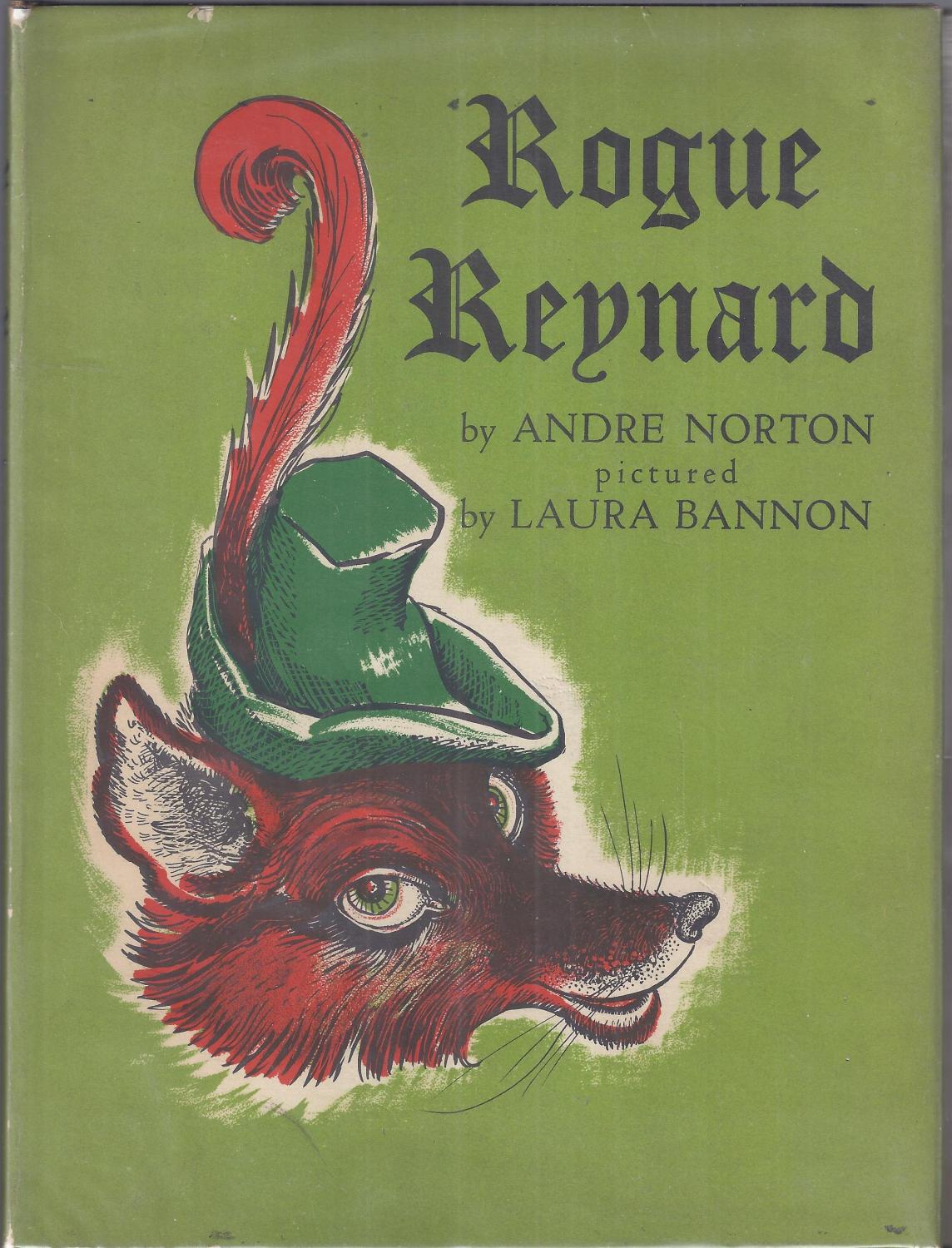
Rogue Reynard another curiosity in the bibliography of Andre Norton. Rogue Reynard is a retelling of the legend of "The Fox and The Hound," told with Norton' usual strong storytelling sense.  Like many of Norton's early books, it gives you the sense that she's simply out to tell a good story, and she doesn't care what form it takes. In this case, she uses more modern language and sensibilities (well, modern for the 1940's when it was written) and applies them to an ancient legend. It's interesting to see that Norton doesn't "dumb down" the story for children, but instead chooses to go with the older versions of the story, which include some pretty graphic violence. (Derek - GoodReads) 

Scarface: the boy Scarface watched the lights of Tortuga dim as the Naughty Lass stood out for the open sea. The Spanish Main promised rich prizes for Captain Cheap and his pirate crew. And this time Cheap had set his sights high—for no less a prey than Sir Robert Scarlett, his lifelong enemy, and Her Majesty’s fleet at Bridgetown. His plan was daring. Muskets roared and swords flashed as redcoats and pirates fought savagely. The fate of Bridgetown hung in the balance—and with it the secret of Scarface’s true identity.

Huon Of The Horn "This is a book that belongs with the great company of the hero tales. It is the later part of the Charlemagne saga, coming after the death of Roland at Roncevaux.  Huon, Duke of Bordeaux, is betrayed by the knight Amaury, just as Roland is betrayed by the Ganelon. To redeem himself in the eyes of the emperor, Huon is sent on a difficult, practically impossible mission to Babylon, which is in the hands of the Saracens--Charlemagne's bitter enemies..."The story is stirring and inspiring. Huon has something of Roland's qualities: charm, courage, a romantic appeal, and the fiery spirit of youth." 

Murders for Sale aka Sneeze On Sunday: When Fredericka Wing arrives in South Sutton, Massachusetts, a tiny New England town, it seems an ideal place for a working summer vacation. She plans on managing Miss Hartwell's bookstore while working on her own writing. She never dreamed she would find a body in a hammock in her own backyard. Someone brutally murdered Catherine Clay, an heir to the Sutton fortune. And more violence follows. Together with Peter Mohun, a professor at a local college, Fredericka sets out to discover the murderer's identity ... and unravel the secrets of the wealthy and powerful Sutton family! 

Yankee Privateer Picaresque adventure in full regalia with its background the privateers of our infant nation during the American Revolution. Young Fitzhugh Lyon, a poor and embittered relation of a rich Virginia family, is going through Baltimore to join the army when he is by accident shanghaied aboard the Retaliation, an intrepid ship without guns, captained by one Crofts. The mistake has been made by Lieutenant Ninnes, and Crofts, finding it out too late, gives Fitz an officer's berth and a chance, as the battle of men and ships plays itself out. After several successful raids, they are captured and put in Plymouth's Old Mill prison. An ingenious escape is plotted and executed, and Fitz' sojourn in England brings the further satisfaction of a successful outcome to a duel fought with one of his English relatives, before he escapes to France. He finds Captain Crofts again, and a softened and repentant Ninnes and a new ship readying for further adventure.

Stand to Horse To Ritchie Peters, a raw recruit in the First Dragoons, the winter of 1859 when he was first stationed at Santa Fe was a tough one. The Apaches attacked and raided in even the foulest weather, and the dragoons had no choice but to go after them, often to meet death by violence, starvation, or freezing. Ritchie slowly adjusted to this life of great hardships, but also of deep loyalties and friendships, and eventually came completely under the spell of this strange and fascinating country. He had "drunk of these waters" and was "part of this land."

Shadow Hawk is a work of historical fiction based on actual events which occurred in ancient Egypt. The story concerns the captain Rahotep, son of the viceroy of the pharaoh and heir to the nomarchy of the Hawk Nome in the southern provinces. The story takes place during the Hyksos occupation, thus Rahotep is given the nickname Shadow Hawk, as his nome is a shadow of its former being. Rahotep intercepts a message from the pharaoh Sekenenre in Thebes to the north, a plea for military assistance to once again unite the Two Lands. Rahotep, along with the commander Methen, faithful friend Kheti, and 10 Nubian archers, travel north to serve their pharaoh. While serving this honorable but unexciting duty, Rahotep is framed as perpetrator in an attempt of pharaoh's life. He is arrested and severely punished but, with the aid of his friends, manages to escape.  The last part of the book concerns the attempt to capture the town, an event that would mark a turning point in the battle with the invading Hyksos to bring about a reversal of Egypt's fortunes. 

Ride Proud, Rebel! is a Civil War novel set in the western theater during the final days of the war.  Drew Rennie has been serving as a cavalry scout in Confederate general John Hunt Morgan's command for two years, having left home in 1862 after a final break with his harsh grandfather, who despised him since his birth because of his mother's runaway marriage to a Texan. Already a seasoned veteran at eighteen, during the final year of conflict Drew has the additional responsibility of looking out for his headstrong fifteen-year-old cousin Boyd, who has run away from home to join Morgan's command and has a lot to learn in the school of hard knocks the army provides. The story follows the two of them and a new friend, a Texas trooper named Anson Kirby who provides both common sense and light comic relief, through campaigns in Kentucky, Tennessee and later on deeper into the South, first with Morgan and later under Forrest.

Rebel Spurs Drew Rennie, discharged from Forrest's Confederate scouts, has come to Arizona in search of the father he hadn't known he had. Drew is posing as Drew Kirby in order to meet Hunt Rennie, the legendary Don Cazar, owner of a matchless range and prize stallions. Things become complicated with a rebel-hating Army commander, local brigands claiming to be Rebel troops, Don Cazar's adopted son, horse racing, horse theft, and more.

Early Sci-Fi

Bullard of the Space Patrol is a sort of Horatio Hornblower of the Space patrol, but written for the YA reader. This is a collection of stories edited and introduced by Norton.  This one is certainly dated, what with it's science rooted in early atomics (The ship uses cannon with explosive shells, "space torpedoes' and has armor). It also some flavor of the Tom Swift novels.  Old School Hard Science SF

Star Man's Son  aka Daybreak 2250 A.D. This 1952 novel really put Andre Norton on the sci-fi map. It takes place after the "Great Blowup". Many areas are still radioactive. Mutated plants and animals abound. Fors is the son of Langdon, a Star Man killed by Beast Things on an exploration into a far city. Fors is rejected by the Star Men due to his white hair, a sign of mutation, and so he and his great hunting cat, Lura, leave on a great journey to search for the lost city in the north that was never bombed and thus is safe for scavengers. 


 Sea Siege  is a standalone SF novel. Twenty-five years after the end of World War II, the threat of war is coming to a peak. East and West have been fighting a covert war for decades, with occasional flare ups into hot war. Now the red plague is killing fish throughout the globe and something strange is happening in the ocean depths. In this novel, Griff Gunston is very upset with his father's lack of attention and casual distrust.  Recently, his father returned and took Griff to live with him on San Isadore in the West Indies. Dr. Gunston is investigating the changes in the seas under in a joint American-British project.  Griff is discussing the war news with Chris and Rob when Captain Murdock rows to the ship. He brings the latest information about the St. John -- another small interisland ship -- which had been found drifting without crew. Then Mosely Peeks, a conch fisherman, brings word of a dupee grounded on the island. Captain Murdock and Griff discover the dupee buried under sea birds and surrounded by crabs. They are amazed at the sight, for the large sea creature looks like a storybook dragon. Still, something is happening in the ocean that is surreal. Humanity has bombed itself into the apocalypse, but something in the sea has helped the destruction to occur. The worst is yet to come.

Star Gate: Almost five centuries past, Terrans had landed their ships on Gorth. Now the Terrans have determined that their presence was not good for the natives and decided to depart Gorth. The summons had gone out to all Terrans and their offspring to gather at the ships. But some did not want to venture into space, so they devised a way to cross timelines.  Kincar s'Rud is Daughter's Son and heir by blood to Styr's Holding. Yet his uncle Jord s'Wurd opposed Kincar's inheritance of the lands. With the departure of the Terran Star Lords, Wurd conceived of another destiny for his daughter's son that would not result in kin war within the Holding. Wurd bestows upon Kincar a scale shirt, sword and surcoat of finest make, but he also directs the boy to leave the Holding before he takes his last breath. This story tells of the experiences of the refugees in a new version of Gorth.

Secret of the Lost Race: a mysterious young man named Joktar, who is a dealer in a gambling house in the Port of N'Yok. He looks much younger than he really is, and the customers mistake him for an easy mark. Nothing could be further from the truth. Joktar was orphaned early and forced to live on the street. He is tough, intelligent, and wary, but Joktar is still swept up in a night-time dragnet meant to find 'volunteers' for forced labor on newly discovered worlds. Matters only go from bad to worse. Before he can be shipped off-planet, Joktar is accused of murder by a man in the gray uniform of the Intergalactic Scouts. His accuser attempts to beat the truth out of him, then has him shipped out to the worst destination in the galaxy: the planet, Fenris in the Constellation of the Wolf. Once on the icy world of Fenris, Joktar is auctioned off to a mining conglomerate but before he reaches his final destination in the alibite mine, he escapes. Okay Norton fans, we're on a strange planet but in otherwise familiar territory: a young outcast pitted against an alien wilderness, hunted by mysterious, unsavory characters.

Central Control series

Star Rangers (aka The Last Planet)  In the waning days of a vast interstellar empire, a lone ship of the Patrol crash lands on a minor, very out of the way planet. Quickly scouting around their crash site, they find evidence of a long vanished high tech civilization in the Sealed Cities, along with nomadic hunter-gatherer level groups of humans. Looking for better shelter to tend their injured personnel, the rangers enter one of the cities, only to find it occupied by another group of refugees and ruled by the Acturian Cummi, a master telepath, one who is not above overpowering and directly controlling other peoples minds, who is bent on becoming the sole ruler of the planet. Zinga, a member of the ancient historian race of Zacathans (a reptilian race that populates many of Norton's science fiction works), and the human Kartr, both high order telepaths themselves, though not of the strength of Cummi, end up in a memorable mental battle with Cummi.

Star Guard: When Terrans learned to travel the space lanes, Central Control assigned them to a special role that suited their aggressive temperament and also provided a safety valve for all other belligerents among the great confederacy. The Terrans became the mercenaries of the Galaxy. Arch Hordes served on the relatively primitive worlds and Mech Legions served on the relatively advanced worlds. However, even the Mechs weapons were less advanced than those available to the Galactic Patrol. Kana Karr, newly graduated Arch Swordsman Third Class, comes to Prime to receive his first assignment. Waiting in the hiring hall, he hears rumors of lost legions and refused assignments. Then, a senior Combatant, accompanied by a Galactic Agent, announces that the troubles on Nevers have been fully investigated, with the assistance of Central Control, and certified that the defeat there was due to local problems and that the rumors concerning this episode are not to be repeated by any of the Corps.  Karr is offered a position with Yorke's Horde and accepts the assignment.  

Astra/Pax series

The Stars Are Ours: Mankind had reached the Moon, Mars and Venus, but found little to justify terraforming, so interplanetary flight was used only for scientific research. However, the three space stations provided a number of services. One of these stations was invaded by unidentified armed men who turned certain installations into weapons which they unleashed against the planet. A major portion of the planet was completely devastated and the loss of life was incalculable. Among the survivors was Arturo Renzi, who had lost his entire family. He began to preach the evils of science and was welcomed as a great leader throughout the world. However, his message was too liberal for some of his followers and he was assassinated. A dictatorship, the Company of Pax, rose up. In this novel,  Dard Nordis, a son of the scientists who resisted the Pax, escaping invading Pax, leads refugees to a new home in the stars.

Star Born When the oppressive global dictatorship of Pax took over the Earth they put a stop to space exploration. Still, a few rebels escaped in the sleeper ships to found free new colonies- or perish in the attempt. Those few colonies that reached inhabitable worlds and survived were cut off for centuries. It was during these centuries of isolation and freedom that they were able to develop the mysterious mental powers that "civilization" had all but destroyed. Finally, when Pax had been eradicated from Earth by the Federation of Free Men, the rockets began to rise once more. This time they they possessed the faster than light drives that would enable them to make up for lost time. One such ship was the RS-10. This ship and its crew stumbled upon the world of Astra and it's strange, ruthless, degenerate, inhuman inhabitants. The Terrans did not trust these creatures but there was much that they could learn from them. Making a temporary alliance the expedition accompanied the aliens to a strange treasure city to help exploit its wonders. It was there that they discovered that the aliens had good reason to fear going to the treasure city alone. It was protected by Free Men who had arrived centuries before....


Crosstime Series


The Crossroads of Time (1956) is the first novel in the Crosstime series. Blake Walker is an entering art student at Havers who is staying in a hotel prior to registering at the school.  In this novel, Blake has a premonition that something dangerous is about to occur in his vicinity and, when it peaks, he is drawn to the corridor.  This story features psionic powers, but lacks many of the other characteristic plot elements of the author's later works. However, the author does include an ordinary kitten who plays a significant role in defeating the villain.


Quest Crosstime  is the sequel to The Crossroads of Time and continues the adventures of Blake Walker, a citizen of our own circa-1950s Earth. A wildly scenic adventure through alternate Earths where Richard III won the Battle of Boswell and the Plantagenets continued to rule in England; Cortez was killed in his final battle with the Aztecs, and the Spanish never established an Empire in the New World. The action never falters as Blake in his disguise as a trader from New Britain continues his search for his missing twin.

Beast Master series

The Beast Master  is the first novel in the Beast Master series. Hosteen Storm is a native of Terra, an Amerindian, a Galactic Commando, and a Beast Master with an unusual affinity with animals, who is mustering out of the service to be repatriated on Arzor. "The last desperate thrust of the Xik invaders had left Terra...a deadly blue, radioactive cinder", leaving the native Terrans homeless and in shock. Some had gone mad, killing themselves and others. Finally, all Terran troops had been forcibly disarmed. Since Hosten has not displayed any symptoms of such delayed shock, the service medics reluctantly agreed they could not deny Storm's release. Storm travels with Baku, Ho, Hing and Surra -- his commando team -- to Arzor on a troop ferry and then looks for employment herding horses to the auction to be held during the Gathering at Irrawady Crossing. To prove his ability to ride, he tames a young stallion and introduces him to Surra, the dune cat. 

Lord of Thunder The sequel to Beast Master. Picking up several months after Storm and his team dealt with the alien presence on the planet Arzor, Storm's new home, this book starts out with a mysterious migration of the native Norbies. They are gathering in large numbers, ignoring old enmities with other tribes, and traveling to forbidden regions. Storm is engaged to search for a crashed human ship at the same time, in the forbidden regions. There were ruins of their presence on Arzor in the previous book, but nothing like that which is found in this one. Storm endures a great deal in his attempt to locate potential survivors of the crash, including facing angry Norbies and dealing with hostile creatures and machinery.

Beast Master's Ark: It is silent. It leaves no tracks. The only evidence that remains is the perfectly cleaned bones of its victims. And it has developed a taste for humans. No one has survived an attack yet, and the natives of Storm's adopted planet, Arzor, are moving in on human territory as they try to escape the silent scourge. The already high tensions between Humans and Natives soar, sparking a race against time as Storm attempts to solve the mystery of Death-which-comes-in-the-Night before Humans and Natives clash. But he can't do it without help from Tani, a genetic engineer from the Ark, a ship traveling space with genetic material from across the galaxy, including the destroyed Earth. But Tani has been poisoned against Beast Masters by her mother. She must conquer her own unreasoning hatred, and awaken the powerful Beast Master in herself, before she and Storm can conquer Death-which-Comes-in-the-Night and uncover the great conspiracy that threatens not only Arzor, but all human-occupied planets.

Beast Master's Circus:  Laris is a young woman who works for a spacefaring circus, a bonded slave to its manager. An orphan with a troubled past, Laris is gifted with animals, a valuable asset to the circus and to her boss. But she's learned that somehow there's a connection between him and the Thieves Guild, and also the attempted abductions of Beast Masters' animals. She also knows that if her boss finds out what she has discovered, it would make her a problem, and he usually disposes of problems. When the circus lands on Arzor, home to Beast Masters Hosteen and Tani Storm, Laris feels a kinship to them and to Hosteen's family, the Quades. She realizes, however, that she may be endangering them by exposing them to the dark interest of her boss and his ill-intentioned friends. Hosteen and Tani like Laris, too, as does Logan Quade. She would give anything to tell them her dangerous secret, but cannot. Because she knows that her friendship with the Beast Masters could be their downfall, as well as her own!

Beast Master's Quest:  When Laris inherits a spaceship from a distant relative, she realizes that she might now fulfill her dream of finding Prauo's home planet. But it won't be easy, and she is relieved when she is able to convince her new extended family to embark with her on a journey into the unknown depths of space. What Laris and her friends find in space, however, tests their beast master abilities and threatens their lives. Prauo's homeworld is beset by dangers the intrepid travelers could not have anticipated. It will take all of their talents and experience to get back to Arzor alive.
 
Solar Queen series

Sargasso of Space Norton's Solar Queen stories are told from the viewpoint of Dane Thorson, an apprentice-Cargo Master who is introduced to us in "Sargasso of Space" as a "lanky, very young man in an ill-fitting Trader's tunic."  After ten years of schooling, orphan Dane Thorson is assigned via a computer analysis of his psychological profile--not to a safe berth on a sleek Company-run starship that his classmates were vying for--but to a battered tramp of a Free Trader. To say that the 'Solar Queen' "lacked a great many refinements and luxurious fittings which the Company ships boasted" was an understatement. But she was a tightly-run ship and what she lacked in refinement, she made up for in adventure. Dane soon settles in under Cargo Master Van Rycke and learns "to his dismay what large gaps unfortunately existed in his training."  The crew of the 'Solar Queen' risk their meager capital in a gamble at a Survey auction, and win trading rights to a barely explored planet with the unlucky name of Limbo. When they view a microfilm (okay, the technology is a bit dated in these books) of their new prize, it appears as though they have purchased ten years of trading rights to a planet that was burned to cinder during the heyday of the mysterious Forerunners, who predated humans in space. Just when the Queen's fortune seems to be at its lowest ebb, a tough-looking archeologist shows up who is supposedly an expert on Forerunner artifacts, and charters her for a voyage to Limbo. It might have been better for the free traders if her captain had kept his ship planeted and declared bankruptcy after the disastrous Survey auction. 

Plague Ship takes the crew of the 'Solar Queen' to Sargol, where the enigmatic feline natives seem very reluctant to trade away their fabulous scented gemstones. When Dane Thorson discovers an herb that the Salariki are willing to swap for their gems, he fears that his eagerness to make a trade breakthrough might have poisoned a native child. That becomes the least of his worries when the 'Solar Queen' blasts off from Sargol with invisible, undetectable stowaways that would brand the free traders anathema to all inhabited worlds. In space, the more senior members of the 'Solar Queen's' crew succumb to a strange plague that resembles sleeping sickness. Dane and his fellow-apprentices, with the assistance of Captain Jellico's Hoobat (a sort of blue parrot-lizard) discover the source of the plague: venomous hitch-hikers from Sargol. "It walked erect on two threads of legs...a bulging abdomen sheathed in the horny substance of a beetle's shell  ended in a sharp point." It was only about a foot-and-a-half high and could change color like a chameleon. The Hoobat kills and eats the first creature, and then the hunt is on for others of its kind. Even with the source of the sleeping sickness discovered, the 'Solar Queen's' young apprentices must still convince the rest of the galaxy that they are not a plague ship--and therefore eligible to be destroyed on sight without warning.

Voodoo Planet  features only Dane, Captain Jellico, and ship's medic, Tau out of the original crew. While the `Queen is being fitted up for her new job as an interstellar mail carrier, the three crew members are invited to Khatka, a planet settled by African refugees from Terra's ancient racial wars. Norton's fascination with magic is woven into this novel via a witch doctor gone over to the Dark Side. Lumbrilo is in league with poachers who are stripping the planet of its native animals. Captain Jellico, Medic Tau, and Dane team up with Khatka's Chief Ranger and his men to track down the off-world thieves and their powerful sorcerer, after their flitter crash-lands in a remote game preserve.

Postmarked the Stars: Trouble started early for the free-trader Solar Queen the moment cargo-master Dane Thorson collected a package for transit from Xecho to Trewsworld. What was in the package Dane did not learn until after he had been kidnapped, knocked out, and a dead man bearing his credentials had been substituted for him aboard the ship. Efforts to find out the reasons for the mysterious switch seemed hopeless until they made the ghastly discovery that their precious cargo of alien embyos had been subjected to secret radiation, causing them to regress genetically into monster forms. Only after Dane and his fellow spacemen had endured a series of nightmare adventures on their port of call did they begin to fit the puzzle together - to realize that they had stumbled upon a criminal operation that involved a whole cluster of stars.

Redline the Stars:  now there's another new crew member: Rael Cofort, half-sister of one of the Queen's chief competitors. Attractive and competent, she just wanted passage to the new port of call, Canuche, in the Halios system. But what seems a simple run becomes a doubly dangerous mission as first a plague of rats and then an explosive crisis on the planetary star docks threaten to end the days of the Solar Queen and wipe out the population of Canuche's capital as well. It's do-or-die time for the Solar Queen...and her mysterious new crew member! (with P.M. Griffin)

Derelict for Trade: Stumbling upon an abandoned ship, Captain Jellico and the crew of the Solar Queen seize the prize and claim the right to salvage the derelict vessel, only to become the targets of a secret alien hijacking ring out to sabotage their claim. (with Sherwood Smith)

A Mind for Trade: On a perilous mission to mine an uncharted planet terrorized by land-shattering storms, the crew of the Solar Queen is threatened by the natives of the planet--a race of mysterious creatures who warn of a coming apocalypse." (with Sherwood Smith)

Time Traders series

The Time Traders: At the end of the Twentieth Century petty crook Ross Murdock is given the choice of facing a new medical procedure called Rehabilitation or volunteering to join a secret government project. Hoping for a chance to escape, Ross volunteers to join Operation Retrograde and is taken by Major John Kelgarries to a base built under the ice near the North Pole. Teamed with archaeologist Gordon Ashe, he is trained to mimic a trader of the Beaker culture of Bronze-Age Europe. Sent back to southern Britain around 2000 B.C.E., Ross and Ashe (as Rossa and Assha) find that their outpost has been bombed, destroyed by the wrath of Lurgha, the local storm god, according to two of the natives. Discovering the direction whence the bomber came and other clues pointing to the general area occupied by the Soviet base, Ross, Ashe, and McNeil, the lone survivor of the bombing, go to that area.


Galactic Derelict is the second solo time agent novel by Andre Norton, and the only one that features all of the main characters-- Gordon Ashe, Ross Murdock, and Travis Fox-- on stage together.  The point-of-view character is a young Apache cowboy and archeologist named Travis Fox who stumbles onto a site manned by various time agents. After some communication over the radio, Fox is told: "Headquarters checked you out all along the line"  and that he has been cleared. The Americans plan to outmaneuver the "Reds" by going back in time, locating an alien spaceship, boarding it, and transporting it into modern times. Everything goes more or less according to plan... up to a point. But when the agents board the ship, a timer preset by the Baldies goes off. The ship takes off with the agents inside, and they are literally lost in space and time. 

The Defiant Agents Travis Fox and other modern day Apaches are transported for colonization to Topaz. They are unwillingly subjected to Redax, a procedure which occurs during stasis. They are mind-linked with their ancient ancestors during transport, and upon arrival are expected to use that knowledge to help survive the early colonization. Upon arrival they crash and encounter modern day Russians, who have also been exposed to their Mongol ancestors' ways. The Russian government is able to control the Mongols' behavior remotely from a ship located on the surface. The Apaches and Mongols must unite and work together to free the colony from the Russian government. There is a nice blend of themes here, with Fox using science and tradition to help him with the problem of modern day oppression. 

Key Out of Time again features Ross Murdock as the hero. Accompanying a group of settlers to the now-empty water-planet Hawaika, he is sent back in time through a Time Gate . . . and must learn to survive ten thousand years in the past!

Firehand a young man finds himself as he teaches guerrilla warfare to a feudal, nonterrestrial offshoot of humanity in order to prepare them properly for a future in which space- and time-traveling humans are battling for survival against murderous aliens. Ross Murdock, a young criminal recruited as a Time Agent for his survival skills, is sent to the Dominion of Virgin, which had abruptly turned from a populous planet to a burned cinder as a result of time-travel by the Baldies, as the aliens are known. The key development that would have saved the planet was the evolution of mental powers that were delayed because of the turmoil following a warlord's conquests 700 years previously. Murdoch, scientist Gordon Ashe and arms expert Eveleen Riordan are sent back in time to Dominion to develop a resistance movement without revealing the existence of Earth or drawing the attention of the Baldies.  (written with P.M. Griffin)

Echoes In Time Time agents Ross Murdock and Eveleen Riorden are recalled from their honeymoon to take part in a dangerous assignment: find a team of Russian scientists who have vanished without a trace from a research mission in the past of a far-off planet. Along with a team of Russian time Agents with their own mysterious agenda and Saba, a new agent teamed with Gordon Ashe, they leap into the alien world's distant history. There they encounter several alien races, whose appearance, language, and customs are almost incomprehensibly strange. Something changed this world, and music seems the only tool that might prove a key to unlocking the planet's secrets. But as they try to decipher a digital alien Rosetta stone, time is running out for their mission. Ross now knows what happened to the missing scientists--but can he save his team before they too vanish forever? (written with Sherwood Smith)

Atlantis Endgame Evidence of time travel has been found in ruins dating to the ancient world . . . in the legendary realm of Atlantis. So Murdock, Ashe, Eveleen Riordan, and other Time Patrollers deck themselves out as foreign traders to discover whether something is amiss in Atlantis. They find that the Baldies are there, as evidenced by sophisticated, high-tech equipment, whose purpose it is impossible to fathom. As they try to derail the Baldies' plot, the Time Patrollers realize that time is running out on their mission, when Atlantis is shaken by tremors that presage a cataclysm that may be the disaster that sank the fabulous island state. But they must be sure they act to preserve, not destroy, history--and if they're wrong, it'll be too late . . . for them and for Earth's future. (written with Sherwood Smith)